Pack Unpack is a relatively simple, optimal approach to serialize relational data in the Teradata database. You can pack multiple columns into a single packed column, useful for downstream apps and API’s that require key \ value pairs. The columns can then be selectively extracted if and when required
Unlike traditional methods of pack\unpacking data using case expressions, derived tables, multi-step queries that use row by row evaluation, Pack \ Unpack simplifies syntax and utilizes set based processing. Using Pack \ Unpack blocks of rows are transformed as a ‘set’ in a single step.
This demo uses a simple banking transaction dataset to illustrate how multiple relational columns can be consolidated into a single packed column and later selectively extracted.
An important behavior to highlight is that packed data is represented as strings. As a result, numeric and temporal types must be safely restored using casting after unpacking. This reflects real-world usage patterns when Pack is used for data movement, schema-on-read, or cross-platform exchange.
Overall, the demonstration shows how Pack and Unpack can be used as a lightweight serialization mechanism inside Teradata, enabling flexible data transport, partial schema reconstruction, and integration-friendly payloads without requiring external formats such as JSON.
Using Teradata Pack Unpack
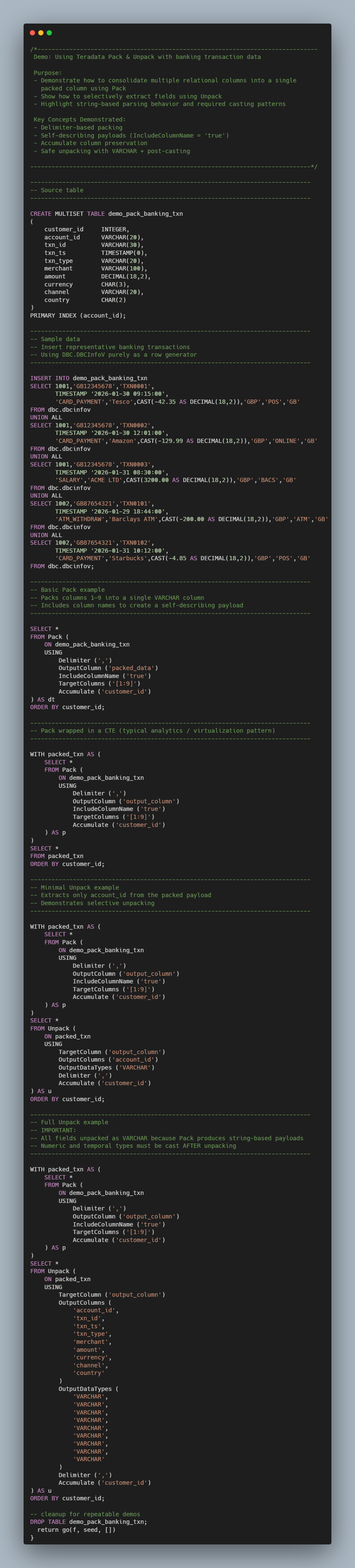
Example of using Teradata’s Pack function to combine transaction fields into a single column and Unpack to reconstruct the original schema.
Link to script pack_unpack.sql
